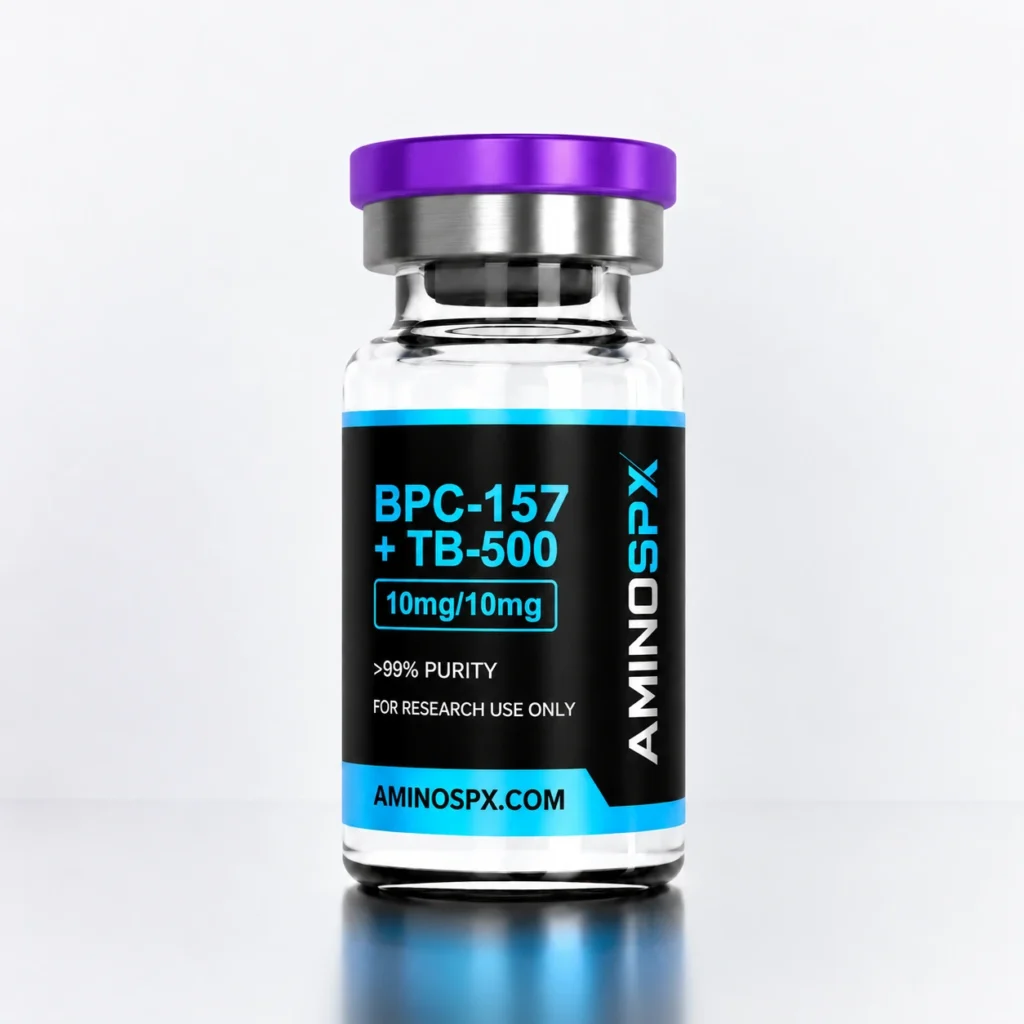
BPC-157 + TB-500
$150.00
AUDBuy BPC-157 + TB-500 Australia
BPC-157 + TB-500 is a dual-peptide research blend studied for its involvement in cellular signalling, cell movement and connective-tissue biology.
Volume discounts
- 2 units 5% off
- 3–4 units 7.5% off
- 5+ units 10% off
Discounts are calculated separately for each product.
Out of Stock
RESEARCH USE ONLY
AMINOSPX products are supplied strictly for legitimate scientific, laboratory and in vitro research.
Not intended for human or animal consumption.
Overview
BPC-157 + TB-500 is a dual-peptide research blend combining two structurally distinct peptides in a single formulation.
BPC-157 is a synthetic 15-amino-acid peptide based on a sequence associated with a protective protein studied in human gastric juice. TB-500 is commonly described as a synthetic fragment associated with Thymosin Beta-4, a naturally occurring 43-amino-acid peptide.
Together, these peptides are investigated in laboratory research involving cellular signalling, tissue organisation, cell migration and connective-tissue biology.
AMINOSPX supplies BPC-157 + TB-500 exclusively for scientific in vitro research, not for human, veterinary, medical, therapeutic or diagnostic use.
Molecular Profile
Total Blend Strength: 20 mg
-
BPC-157 10mg
-
TB-500 10mg
Research Applications
Research involving the individual peptides BPC-157 and TB-500 covers several areas, including:
Tissue Structure
Research examines how the individual peptides interact with cells involved in tissue organisation and remodelling.
Cell Movement
Examines cellular movement and organisation during experimental tissue remodelling.
Blood Vessel Formation
Explores endothelial signalling associated with blood vessel formation.
Collagen & Tissue Organisation
Focuses on collagen-related processes and how cells organise the surrounding connective-tissue framework.
Supporting Research
Explore published scientific research relevant to BPC-157 + TB-500.
Research Disclaimer
Information provided on this page is supplied solely for laboratory, analytical, scientific and in vitro research purposes. Products are not intended for human or veterinary use, and the information provided does not constitute medical, pharmaceutical, healthcare or other professional advice.
Nothing contained on this website should be interpreted as a recommendation regarding the diagnosis, treatment, prevention or management of any disease, condition or health outcome.
Researchers are responsible for determining the suitability of products for their intended laboratory applications and for ensuring compliance with all applicable laws, regulations and institutional requirements.
Storage & Handling
Storage Recommendations
- Store the lyophilised compound sealed and dry below 25°C.
- Once reconstituted, store at 2-8°C.
- Minimise repeated freeze–thaw cycles.
- Protect from heat, moisture and direct light.
Handling Recommendations
- Handle compounds in a clean, controlled environment to minimise contamination.
- Use sterile practices and follow product-specific preparation and reconstitution protocols.
- Maintain accurate records of product identification and handling.
- Avoid direct contact with skin or eyes, and prevent inhalation or ingestion.
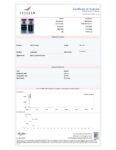
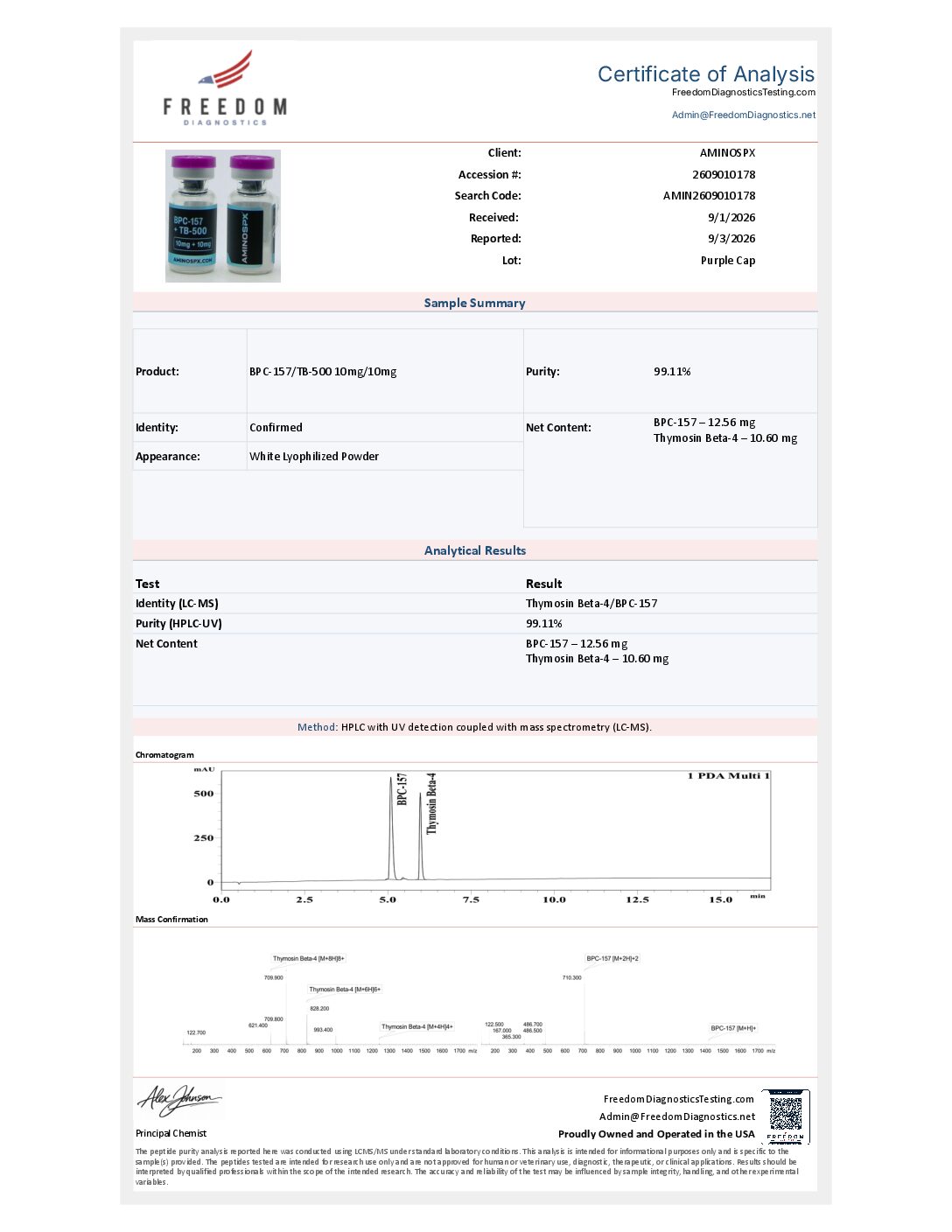
Certificate of Analysis (COA)
Important Information
Certificates of Analysis are obtained through independent third-party analytical laboratories and provided for research and informational purposes only.
Compounds tested are intended for research use only and are not approved for human or veterinary use, diagnostic, therapeutic or clinical applications.
Results should be interpreted by qualified professionals within the scope of the intended research and should not be considered a guarantee of suitability for any particular application.
Frequently Asked Questions
Why are BPC-157 and TB-500 combined in one blend?
The formulation brings together two different research peptides, allowing their characteristics and interactions to be examined within the same experimental setting.
Does combining the peptides change their individual properties?
Combining peptides creates a mixture, but it does not automatically change their individual molecular identities. Stability, compatibility and interactions must be evaluated separately.
Is TB-500 the same as Thymosin Beta-4?
Not necessarily. TB-500 is used commercially for different Thymosin Beta-4-related peptide sequences, so the exact molecular identity should be confirmed through product specifications.
Has the BPC-157 + TB-500 combination been extensively studied?
Research on the individual peptides is more established than research on the specific combination. Findings involving either peptide alone cannot automatically be applied to the blend.
Customer Reviews
Be the first to leave a review
Share your experience with this product and help other researchers make informed decisions.
Share your experience.