Peptides
New

WELCOME TO AMINOSPX
Before entering, please confirm that you understand and agree to the following:
Price range: $70.00 through $280.00
AUDBuy SS-31 Australia
SS-31 (Elamipretide) is a synthetic peptide studied for its interactions with mitochondrial membranes, cellular energy metabolism and oxidative stress pathways.
Volume discounts
Discounts are calculated separately for each product.
Out of Stock
RESEARCH USE ONLY
AMINOSPX products are supplied strictly for legitimate scientific, laboratory and in vitro research.
Not intended for human or animal consumption.
SS-31, also known as Elamipretide, is a synthetic peptide made up of four amino acids, designed to interact with mitochondria, the structures responsible for much of a cell’s energy production.
It associates with cardiolipin, a specialised lipid found in the inner mitochondrial membrane. This interaction has made SS-31 a subject of research into mitochondrial membrane structure, cellular energy processes and oxidative stress.
AMINOSPX supplies SS-31 exclusively for scientific in vitro research, not for human, veterinary, medical, therapeutic or diagnostic use.
Key areas of scientific research involving SS-31 include:
Mitochondrial Function
Examines how SS-31 interacts with mitochondria and the processes involved in cellular energy metabolism.
Mitochondrial Membrane Stability
Explores how the peptide's interaction with cardiolipin relates to the structure and stability of inner mitochondrial membranes.
Oxidative Stress
Investigates changes in reactive oxygen species and oxidative stress-related signalling in experimental models.
Cellular Energy Production
Focuses on the relationship between SS-31, mitochondrial respiration and the processes cells use to generate energy.
Research Disclaimer
Information provided on this page is supplied solely for laboratory, analytical, scientific and in vitro research purposes. Products are not intended for human or veterinary use, and the information provided does not constitute medical, pharmaceutical, healthcare or other professional advice.
Nothing contained on this website should be interpreted as a recommendation regarding the diagnosis, treatment, prevention or management of any disease, condition or health outcome.
Researchers are responsible for determining the suitability of products for their intended laboratory applications and for ensuring compliance with all applicable laws, regulations and institutional requirements.
Important Information
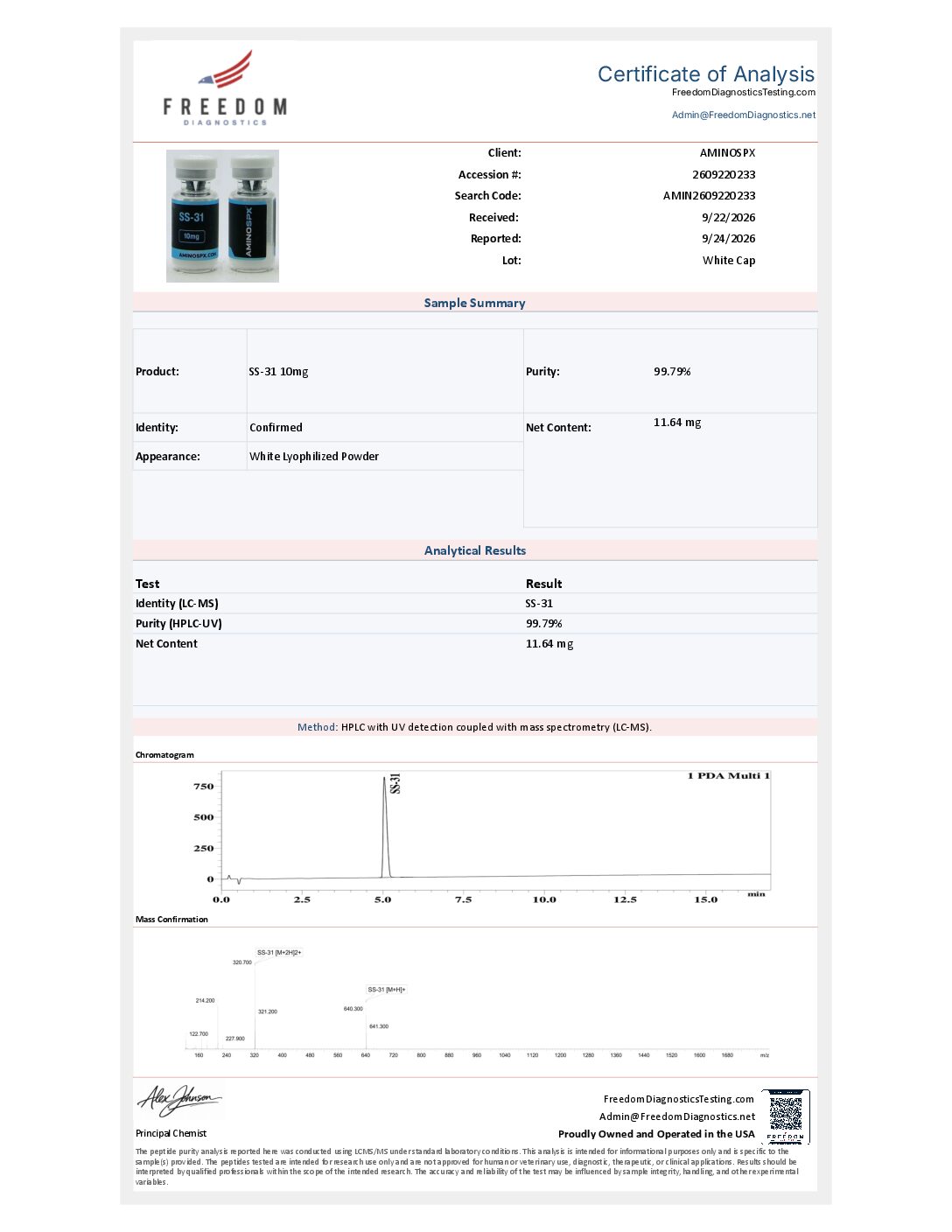
Certificates of Analysis are obtained through independent third-party analytical laboratories and provided for research and informational purposes only.
Compounds tested are intended for research use only and are not approved for human or veterinary use, diagnostic, therapeutic or clinical applications.
Results should be interpreted by qualified professionals within the scope of the intended research and should not be considered a guarantee of suitability for any particular application.
SS-31 is also called Elamipretide. It belongs to the Szeto–Schiller family of synthetic peptides and contains four amino acids.
SS-31 is studied for its interaction with mitochondrial membranes, particularly cardiolipin. This differs from MOTS-C, which is encoded by mitochondrial DNA and associated with metabolic signalling.
Cardiolipin is a specialised lipid found mainly in the inner mitochondrial membrane. It helps organise proteins involved in cellular energy production.
Experimental studies examine how its interaction with mitochondrial membranes may influence cellular respiration and reactive oxygen species, which are involved in oxidative stress.
Share your experience with this product and help other researchers make informed decisions.
Share your experience.