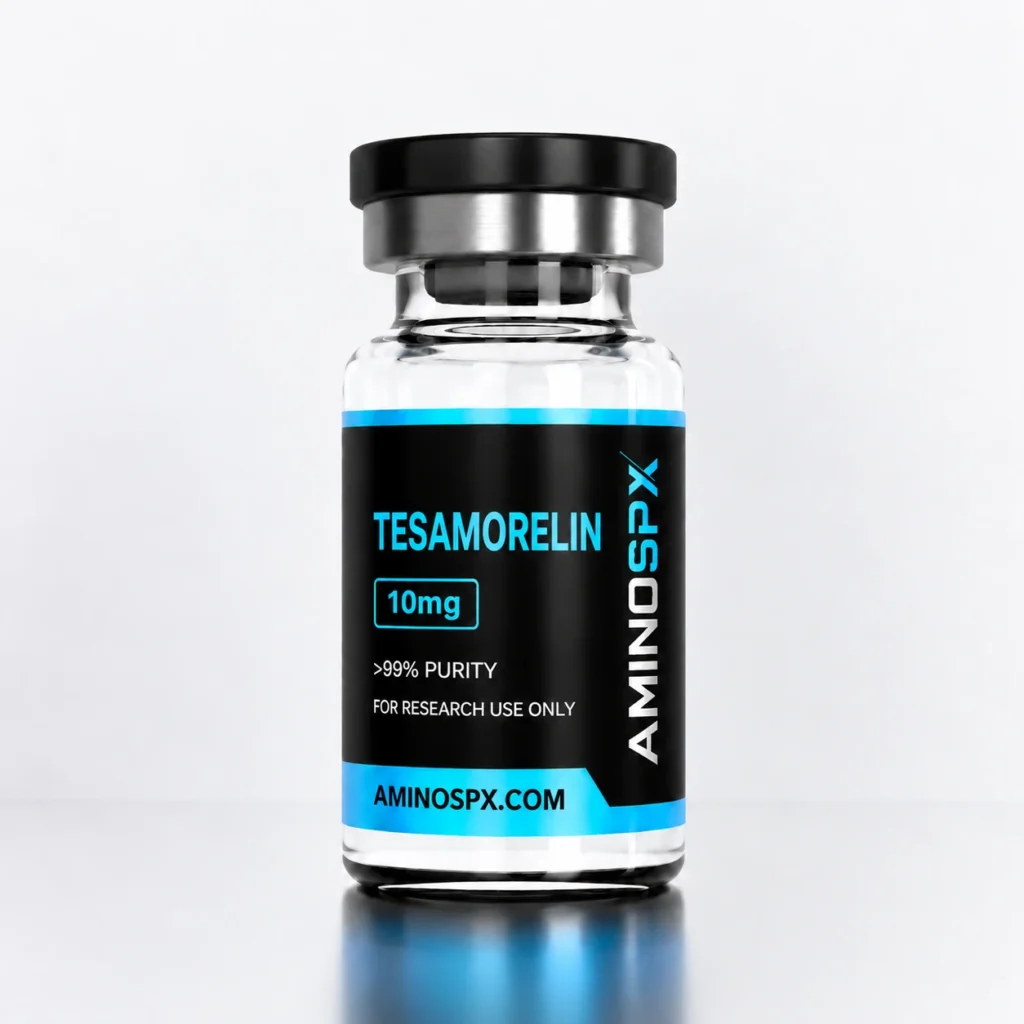
TESAMORELIN
Price range: $99.00 through $220.00
AUDBuy TESAMORELIN Australia
Tesamorelin is a synthetic analogue of growth hormone-releasing hormone (GHRH), studied for its interactions with pituitary receptors, growth hormone signalling and endocrine regulation.
Volume discounts
- 2 units 5% off
- 3–4 units 7.5% off
- 5+ units 10% off
Discounts are calculated separately for each product.
Out of Stock
RESEARCH USE ONLY
AMINOSPX products are supplied strictly for legitimate scientific, laboratory and in vitro research.
Not intended for human or animal consumption.
Overview
Tesamorelin is a synthetic peptide based on growth hormone-releasing hormone (GHRH), a naturally occurring hormone that signals the pituitary gland to release growth hormone.
It contains a structural modification designed to improve peptide stability while retaining GHRH receptor activity. These characteristics make Tesamorelin relevant to research into growth hormone signalling, receptor interactions and communication between the brain and pituitary gland.
AMINOSPX supplies Tesamorelin exclusively for scientific in vitro research, not for human, veterinary, medical, therapeutic or diagnostic use.
Molecular Profile
- Molecular Name
- Tesamorelin
- Chemical Classification
- Synthetic Growth Hormone-Releasing Factor (GRF 1–44) Analogue
- Molecular Formula
- C221H366N72O67S
- Molecular Weight
- 5135.8 g/mol
- Length
- 44 Amino Acids
- CAS
- 218949-48-5
- PubChem CID
- 16137828
- Form
- Lyophilised Powder
- Color
- White
- Purity
- >99% HPLC
- Verification
- Third-Party Laboratory Tested
- Packaging
- Sterile Vial
Research Applications
Key areas of scientific research involving Tesamorelin include:
Growth Hormone Release
Examines how GHRH receptor activation relates to growth hormone secretion from the pituitary gland.
GH & IGF-1 Activity
Explores growth hormone signalling and its relationship with downstream IGF-1 pathways.
Hormone Release Patterns
Investigates the timing and regulation of growth hormone release following GHRH receptor activation.
Hormonal Communication
Focuses on signalling between the hypothalamus and pituitary gland involved in hormone regulation.
Research Disclaimer
Information provided on this page is supplied solely for laboratory, analytical, scientific and in vitro research purposes. Products are not intended for human or veterinary use, and the information provided does not constitute medical, pharmaceutical, healthcare or other professional advice.
Nothing contained on this website should be interpreted as a recommendation regarding the diagnosis, treatment, prevention or management of any disease, condition or health outcome.
Researchers are responsible for determining the suitability of products for their intended laboratory applications and for ensuring compliance with all applicable laws, regulations and institutional requirements.
Storage & Handling
Storage Recommendations
- Store the lyophilised compound sealed and dry below 25°C.
- Once reconstituted, store at 2-8°C.
- Minimise repeated freeze–thaw cycles.
- Protect from heat, moisture and direct light.
Handling Recommendations
- Handle compounds in a clean, controlled environment to minimise contamination.
- Use sterile practices and follow product-specific preparation and reconstitution protocols.
- Maintain accurate records of product identification and handling.
- Avoid direct contact with skin or eyes, and prevent inhalation or ingestion.
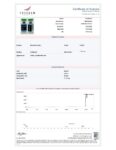
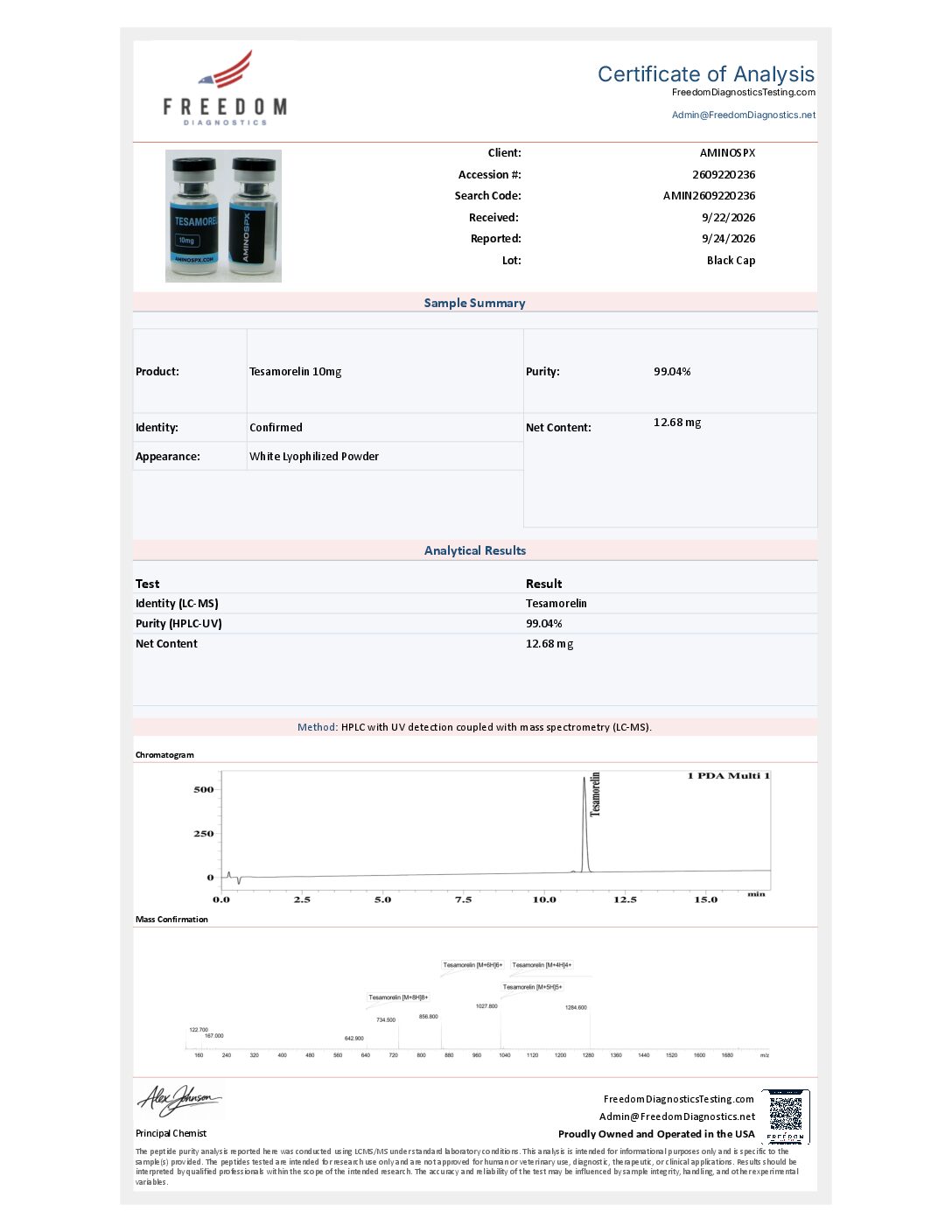
Certificate of Analysis (COA)
Important Information
Certificates of Analysis are obtained through independent third-party analytical laboratories and provided for research and informational purposes only.
Compounds tested are intended for research use only and are not approved for human or veterinary use, diagnostic, therapeutic or clinical applications.
Results should be interpreted by qualified professionals within the scope of the intended research and should not be considered a guarantee of suitability for any particular application.
Frequently Asked Questions
Is Tesamorelin a form of growth hormone?
No. Tesamorelin is a modified analogue of Growth Hormone-Releasing Hormone (GHRH). It interacts with GHRH receptors rather than being growth hormone itself.
How is Tesamorelin different from CJC-1295?
Both are associated with GHRH receptor signalling, but they have different peptide structures and chemical modifications. Tesamorelin is based on a 44-amino-acid GHRH sequence.
What makes Tesamorelin more stable than natural GHRH?
Tesamorelin contains an N-terminal trans-3-hexenoyl modification. This changes how the peptide behaves and helps protect it against certain forms of enzymatic degradation.
Why is Tesamorelin associated with IGF-1 research?
Growth hormone signalling can influence the production of IGF-1. Tesamorelin's interaction with GHRH receptors makes it relevant to research examining this relationship.
Customer Reviews
Be the first to leave a review
Share your experience with this product and help other researchers make informed decisions.
Share your experience.